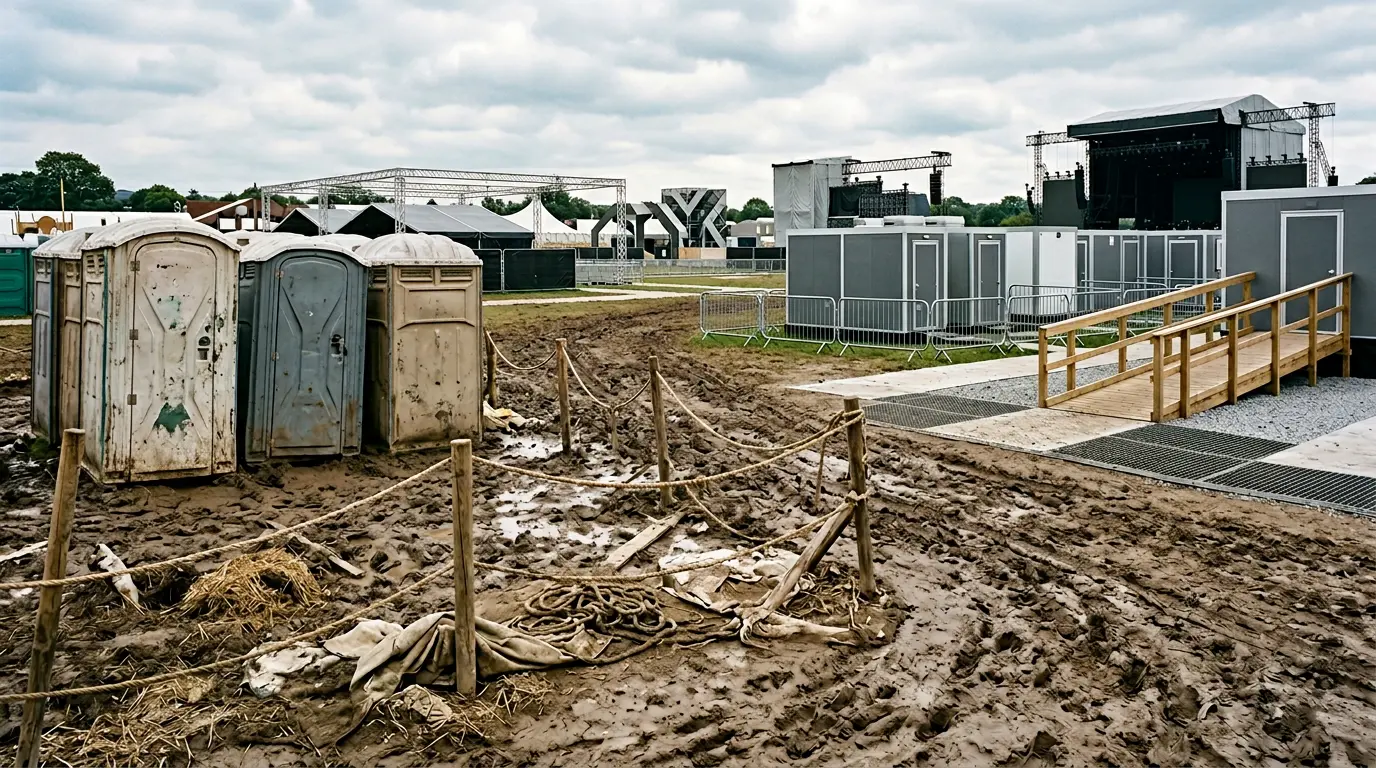
While Woodstock is celebrated as a moment of spontaneous counter-cultural magic, its legendary chaos was a direct result of operational negligence that is now legally impossible and ethically unthinkable.
- Basic infrastructure like sanitation and water failed catastrophically, violating every modern public health standard.
- The lack of perimeter security and ticketing created a financial disaster and an uncontrollable, unsafe environment.
- Key systems for sound and artist transport were single points of failure, a risk no modern event would tolerate.
Recommendation: Acknowledge that the ‘spirit’ of Woodstock cannot be separated from its pre-regulatory context; modern festivals must prioritize a non-negotiable duty of care over spontaneous chaos.
As a festival operations director, I look at the legend of Woodstock with a mix of professional admiration and sheer terror. We celebrate it as a pinnacle of the counter-culture movement, a spontaneous gathering of 400,000 people for three days of peace and music. The cultural myth is powerful, shaped by an Oscar-winning documentary that focused on smiling faces in the rain and a communal spirit. But when viewed through the cold, hard lens of modern event management, Woodstock isn’t a blueprint; it’s a case study in catastrophic failure. The conversation often revolves around simplistic ideas of inadequate toilets or food shortages, but this misses the fundamental point.
The ‘magic’ of Woodstock was inextricably linked to a near-total absence of a regulatory framework. Its logistical collapse wasn’t just a series of mistakes; it was the outcome of an approach that would be shut down by authorities before the first tent was ever pitched today. The core principles of modern festival production—risk assessment, contingency planning, and an overriding ‘duty of care’ for every single attendee—were concepts from a distant future. To understand why Woodstock could never happen now, we must move beyond the romanticism and conduct a pragmatic post-mortem, analyzing its key failures against the rigid standards of today’s highly regulated, safety-conscious industry.
This analysis isn’t about tarnishing a legend. It’s about recognizing that the world has, for good reason, changed. From sanitation engineering and crowd control to artist contracts and environmental law, the entire ecosystem of putting on a large-scale event has been professionalized to prevent the very chaos that defined 1969. We will dissect exactly where and why the original festival would fail, not just as a business, but as a legally compliant and safe public gathering.
This article provides a detailed breakdown of the critical operational differences between the legendary 1969 event and the requirements for any major festival today. The following sections will explore the specific logistical, financial, and technical reasons why Woodstock’s model is an impossible relic.
Summary: Why Woodstock’s Logistics Are Unrepeatable
- Porta-Potties and Water: Why Infrastructure is the Real Headliner of Any Festival?
- Why Declaring a Festival « Free » Was a Financial Disaster but a Cultural Victory?
- How Did the Booking of Woodstock define the Careers of Santana and Hendrix?
- The Documentary Mistake That Hides the Mud and Hunger of the Reality
- Could a « New Woodstock » Ever Happen in the Internet Age?
- Why Festivals Became Temporary Autonomous Zones for the Counterculture?
- Why the Sound at the Main Stage Might Be Worse Than the Smaller Tents?
- How to Secure Tickets and Plan Logistics for a Major Festival Like Glastonbury?
Porta-Potties and Water: Why Infrastructure is the Real Headliner of Any Festival?
From an operational standpoint, the most glamorous headliner on any festival bill is invisible: the sanitation and water infrastructure. This is where Woodstock’s failure was most immediate and dangerous. For an audience that swelled to over 400,000, organizers provided a shockingly low number of facilities. While exact figures vary, historical records confirm that Woodstock provided approximately 600 portable toilets. This created a ratio of about one toilet for every 667 attendees. The result was a public health emergency, with overflowing facilities and widespread contamination. The few water wells on site were quickly overwhelmed, forcing people to turn to questionable water sources.
To put this in perspective, modern standards are exponentially stricter. In the UK, for example, the industry bible for event safety, the Purple Guide mandates a minimum ratio of roughly one female toilet per 100 attendees and one male toilet per 500 attendees (plus urinals). This isn’t a suggestion; it’s a condition of being granted a license. A modern event planner would face immediate shutdown and massive fines for proposing Woodstock’s sanitation plan. The duty of care legally requires organizers to provide adequate, clean, and accessible facilities, not as an afterthought, but as a core component of the site build.

Today, infrastructure is a science. We use sophisticated modeling to predict peak demand times, plan for waste removal logistics, and ensure potable water is available at tested distribution points across the entire site. The lesson from Woodstock is clear and has been codified into law and best practice: the health and safety of the audience is paramount, and it begins with the unglamorous but non-negotiable basics. Infrastructure is the true headliner that makes every other performance possible.
Why Declaring a Festival « Free » Was a Financial Disaster but a Cultural Victory?
Woodstock was never intended to be a free event. It became one by default, a testament to a complete failure in perimeter security and access control. The organizers were overwhelmed when hundreds of thousands of people arrived before the fences and ticket booths could be completed. Faced with an uncontrollable situation, they made the fateful decision to declare it a free festival. While this move cemented Woodstock’s legend as a utopian gathering free from commercialism, it was an unmitigated financial disaster that pushed the promoters to the brink of bankruptcy.
Without ticket revenue, the primary income stream vanished. The situation was compounded by a failure to secure adequate commercial partners. As a logistical analysis in Prevue Meetings & Incentives, citing Smithsonian research, points out, the event’s sheer, projected scale was a deterrent:
the established food vendors didn’t want to have anything to do with the festival, mostly because of its projected size
– Smithsonian Institution research, Prevue Meetings & Incentives logistical analysis
This led to severe food shortages, famously supplemented by the Hog Farm collective and local residents. In today’s festival landscape, this model is unthinkable. Perimeter integrity is the first line of defense for both safety and financial viability. Modern festivals employ multi-layered security, robust fencing, and sophisticated ticketing systems (like RFID wristbands) to precisely control the number of people on site. This isn’t about greed; it’s about fulfilling the legal duty of care. An uncontrolled crowd size makes it impossible to plan for medical, sanitation, and security needs, creating immense liability. Revenue is also diversified through tiered ticketing (VIP packages), official merchandise, and strategic brand partnerships, ensuring the event can actually pay its staff, artists, and suppliers.
How Did the Booking of Woodstock define the Careers of Santana and Hendrix?
The chaos of Woodstock’s logistics had a direct and profound impact on its artistic legacy, most famously for launching the career of a then-unknown Carlos Santana. The festival’s scheduling fell apart almost immediately as traffic gridlock made the rural roads impassable. Major, established acts were stuck miles away, unable to reach the site. With a massive, restless crowd and an empty stage, the frantic promoters needed to fill the time. They pushed Santana, a relatively local act, into the spotlight. That impromptu, fiery performance, captured in the documentary, was a revelation. It transformed the band from a regional curiosity into an international phenomenon overnight. This was a career-defining moment born entirely from logistical collapse.
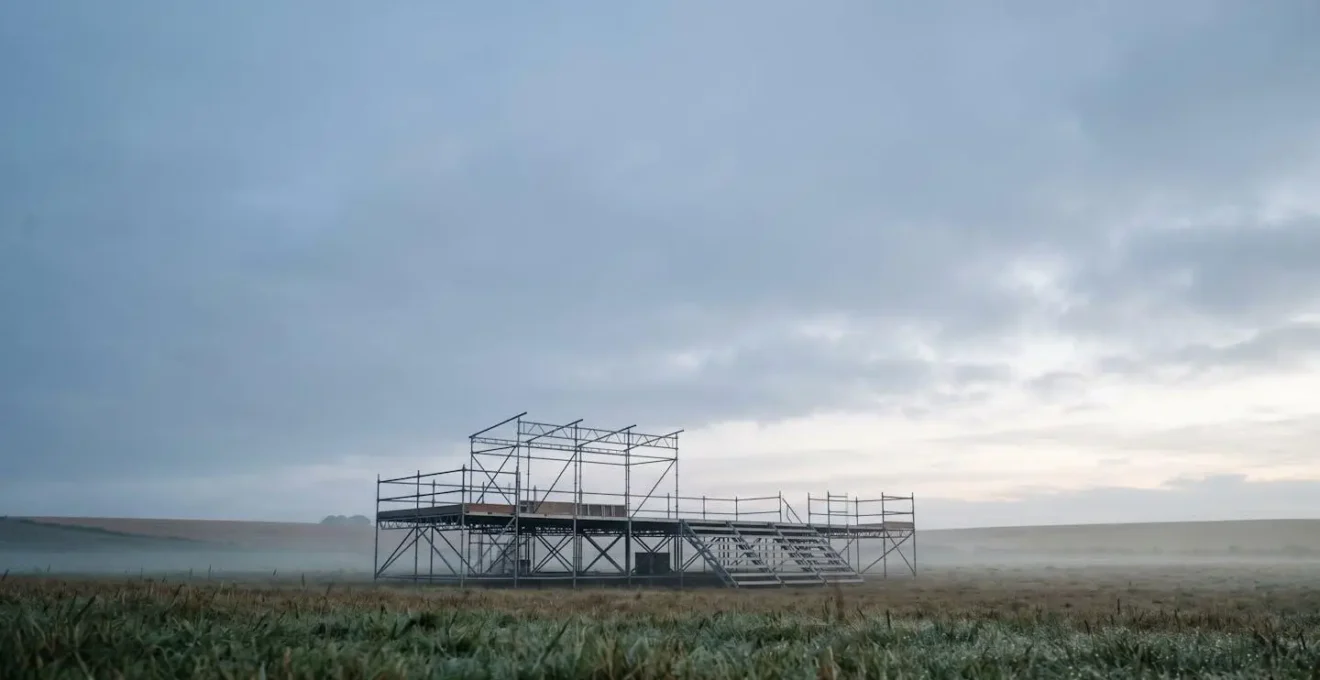
Conversely, Jimi Hendrix’s iconic, festival-closing performance of « The Star-Spangled Banner » was witnessed by a fraction of the original audience. Due to cascading delays, he didn’t take the stage until 9:00 AM on Monday morning, by which time the vast majority of the 400,000 attendees had already left. The moment became legendary through the film, but for most people on the ground, it never happened. Both instances highlight a complete lack of contingency planning for artist transport and scheduling.
Today, this would be unacceptable. Artist contracts are ironclad legal documents with detailed riders specifying everything from sound requirements to transport logistics. For a festival of this scale, guaranteed helicopter access is standard for headliners, ensuring they can bypass any ground-level chaos. Schedules are managed with sophisticated software, with backup plans and alternate artists ready to go. The happy accident of Santana’s discovery is a great story, but for a modern promoter, it represents a high-stakes gamble that introduces unacceptable levels of risk and potential breach of contract lawsuits.
The Documentary Mistake That Hides the Mud and Hunger of the Reality
Our collective memory of Woodstock is not of the event itself, but of Michael Wadleigh’s 1970 documentary. The film is a masterful piece of storytelling, but as an operational record, it is deeply misleading. It strategically curated a narrative of peace and communal spirit, focusing on beautiful moments of unity while conveniently downplaying the grim reality on the ground. The overflowing toilets, the mud-caked attendees suffering from exposure, the rampant medical emergencies, and the severe food shortages were largely left on the cutting room floor. The film hides the fact that the situation was so dire that Governor Nelson Rockefeller considered deploying the National Guard to deal with what was officially declared a disaster area.
The gap between the cinematic myth and the archaeological truth is vast. As detailed in a study by Atlas Obscura, excavations of the site 50 years later revealed the true extent of the environmental aftermath, including significant soil contamination from the widespread waste. The documentary created a powerful, sanitized myth, but it was a myth nonetheless. In today’s world, such a singular, curated narrative would be impossible to maintain. Imagine the scene with 400,000 attendees, each equipped with a smartphone. The reality of the festival would be broadcast to the world in real-time through a million fragmented, unedited clips on TikTok, Instagram, and Twitter.
There would be no single editor to craft a romantic narrative. The world would see the overflowing sanitation facilities, the overwhelmed medical tents, and the desperate search for food and water as it happened. This uncontrollable, real-time documentation would not only shatter the myth but also create a massive public relations and liability crisis for the organizers. The curated narrative of the Woodstock film was a product of its time; in the internet age, radical transparency, whether voluntary or not, is the default.
Could a « New Woodstock » Ever Happen in the Internet Age?
The question of whether a « new Woodstock » could happen today is often met with a simple « no, » usually citing the internet or a cynical modern culture. But the real answer is far more pragmatic and rooted in technology and regulation. A spontaneous, uncontrolled gathering of that magnitude is impossible not because the spirit is gone, but because the tools of control and the legal expectations of safety are absolute. The modern festival is a high-tech, data-driven environment. Forget open fields and a general sense of how many people are there; contemporary festivals utilize a data-driven environment with cashless systems, RFID wristbands, and real-time crowd monitoring.
These RFID wristbands are central to modern operations. They are the ticket, the wallet, and a tracking device all in one. Organizers know exactly who is on site, where they are, and can manage crowd flow in real-time to prevent dangerous density in front of stages or at bottlenecks. This technology allows for precise capacity management, which is a legal requirement. Any event that exceeds its licensed capacity faces immediate shutdown and prosecution. The idea of an extra 200,000 people simply walking in is a literal impossibility in a system where every entry is scanned electronically.
Furthermore, social media acts as an accelerant for logistics. In 1969, news of the festival’s location spread by word of mouth and radio, a relatively slow process. Today, a single tweet or TikTok video could send tens of thousands of un-ticketed people towards a site in a matter of hours, creating a public safety nightmare that police and emergency services are now trained to prevent preemptively. The digital perimeter is just as important as the physical one. For all these reasons, the beautiful, anarchic chaos of Woodstock is confined to history, replaced by a non-negotiable framework of technology, data, and regulatory control.
Why Festivals Became Temporary Autonomous Zones for the Counterculture?
Despite the operational chaos, or perhaps because of it, Woodstock succeeded in creating something culturally profound: a Temporary Autonomous Zone (TAZ). Coined by writer Hakim Bey, a TAZ is a self-governing space that exists outside the norms of the established state for a brief period. With the fences down, the promoters losing control, and the authorities hesitant to intervene, the 400,000 attendees at Woodstock essentially formed a pop-up city. They created their own social rules, systems of mutual aid, and a shared identity rooted in the counter-culture movement.
This was a community forged in adversity. When the official food supplies ran out, the Hog Farm commune and local residents stepped in to provide free meals. When medical services were overwhelmed, people looked after one another. This spirit of cooperation and anti-commercialism is at the heart of the Woodstock myth. It was a space where the values of the counter-culture—community over capital, experience over ownership—were lived out on a massive scale. As archaeologist Maria O’Donovan noted in her study of the site for Atlas Obscura, the driving force was different:
It wasn’t driven by the almighty buck
– Archaeologist O’Donovan, Atlas Obscura archaeological study of Woodstock site

This accidental creation of a TAZ is precisely what makes Woodstock both legendary and unrepeatable. The very lack of control that a modern operations director fears was the fertile ground for this unique social experiment. In today’s highly regulated and insured world, an organizer has a legal ‘duty of care’ that makes the concept of a TAZ an unacceptable liability. Every square foot of the festival site is planned, managed, and controlled. While modern festivals strive to create a sense of community, it is a curated community within a tightly controlled environment, not a truly autonomous one born from systemic collapse.
Why the Sound at the Main Stage Might Be Worse Than the Smaller Tents?
For its time, the sound system at Woodstock, engineered by the legendary Bill Hanley, was revolutionary. It was an enormous, custom-built system designed to deliver sound to a massive audience. However, it was also a perfect example of a single point of failure. The entire system was a centralized configuration of speaker towers located at the stage, designed for an anticipated crowd of 50,000, not the 400,000 who ultimately showed up. As the crowd swelled and spread across the vast, unplanned contours of the natural amphitheater, the acoustics became chaotic. The sheer number of human bodies absorbed and deflected the sound waves in unpredictable ways, creating dead spots and areas with unintelligible audio.
This centralized, brute-force approach is the antithesis of modern large-scale sound design. Today, a main stage system for 100,000+ people is a distributed network. It uses multiple, smaller speaker towers (known as delay towers) placed strategically throughout the audience area. Each tower receives a slightly delayed audio signal, calculated with sophisticated software like L-Acoustics Soundvision before the first piece of equipment is ever loaded in. This software models the terrain and predicts acoustic coverage, ensuring that a person standing half a mile away experiences the same clear, powerful sound as someone in the front row. This distributed design also builds in redundancy; if one tower fails, the entire system doesn’t collapse.
Ironically, this is why the sound in a smaller festival tent today can often be sonically superior to the main stage. A tent is a controlled acoustic environment. Sound engineers can manage reflections and ensure optimal clarity in a way that is simply impossible in an open field with a six-figure crowd. Woodstock pushed the limits of what was possible with centralized audio, and its failure taught the industry a vital lesson: in sound, as in all logistics, distribution and redundancy trump brute force.
Key Takeaways
- Woodstock’s ‘magic’ was a direct result of operational and regulatory failures that are now illegal and insured against.
- Modern festivals are defined by a legal « duty of care, » requiring extensive contingency planning for sanitation, security, and safety that was absent in 1969.
- Technology like RFID wristbands and data-driven crowd monitoring makes the spontaneous, uncontrolled nature of Woodstock impossible to replicate.
How to Secure Tickets and Plan Logistics for a Major Festival Like Glastonbury?
If Woodstock represents the chaotic, spontaneous model of a festival, then the UK’s Glastonbury Festival is its polar opposite: a masterclass in long-term, highly regulated logistical planning. It is the ‘anti-Woodstock’ in every operational sense, and its success provides the definitive answer to how a modern mega-festival is managed. The core difference begins with access: there is no « free festival » by accident at Glastonbury. Securing a ticket is a multi-step process designed to prevent overcrowding and fraud.
The entire operation is a case study in resilience engineering. Where Woodstock reacted to chaos, Glastonbury pro-actively plans for worst-case scenarios, from weather to security. This meticulous planning is the only way an event of its scale—hosting over 200,000 people on a 900-acre site—can legally and safely operate. Furthermore, the environmental aspect is now a primary legal hurdle. Whereas Woodstock’s aftermath required a massive cleanup of a contaminated site, contemporary festival regulations mandate Environmental Impact Assessments (EIAs), soil contamination testing, and multi-million dollar cleanup bonds before a license is even considered. This alone would have made Woodstock’s impromptu site change and lack of planning a non-starter.
Action Plan: The Glastonbury Anti-Woodstock Model
- Photo Registration System: All potential attendees must pre-register with a passport-style photo months in advance, creating a database of who is authorized to be on-site—the exact opposite of Woodstock’s anonymous crowd.
- Lottery-Based Non-Transferable Tickets: Tickets are allocated via a lottery system and are tied directly to the registered photo, making scalping and forgeries nearly impossible and ensuring strict capacity control.
- Multi-Year Site Infrastructure Planning: Glastonbury is a permanent, year-round operation. Miles of temporary roadways, drainage systems, and water pipelines are pre-installed, and planning involves years of coordination with local councils, emergency services, and transport authorities.
- Peak Demand Sanitation Engineering: Adhering strictly to Purple Guide standards, Glastonbury calculates sanitation needs based on peak crowd density, not averages, and pre-positions service vehicles in dedicated corridors to avoid interfering with festival-goers.
- Contingency Planning for the Unplannable: The infamous Glastonbury mud is not a surprise; it’s a planned contingency. The site’s robust drainage and pre-laid trackways are designed to handle the worst-case weather, a stark contrast to Woodstock’s reactive chaos.
The lesson is clear. The path from the beautiful anarchy of Woodstock to the organized complexity of Glastonbury is paved with decades of learning, technological advancement, and, most importantly, a regulatory framework that prioritizes the safety and well-being of every single person on site.
Ultimately, analyzing Woodstock through a modern lens demonstrates that creating a safe, successful large-scale festival is a complex, professional discipline. It requires meticulous planning, a deep understanding of legal and regulatory obligations, and a commitment to a duty of care that was simply not part of the equation in 1969.